I admit that I haven't read much on beekeeping. I'm reading a bit about diseases that can threaten honey bees. It's amazing to me that tracheal mites are a big problam. We're talking about tiny creatures that clog the breathing tubes of adult bees. So bees have asthma?
I'm reading enough so that I can be on the lookout. Should my hives get a sniffle -- is that a life threatening illness or the common cold?
Otherwise I'm hoping my bees will teach me about themselves.
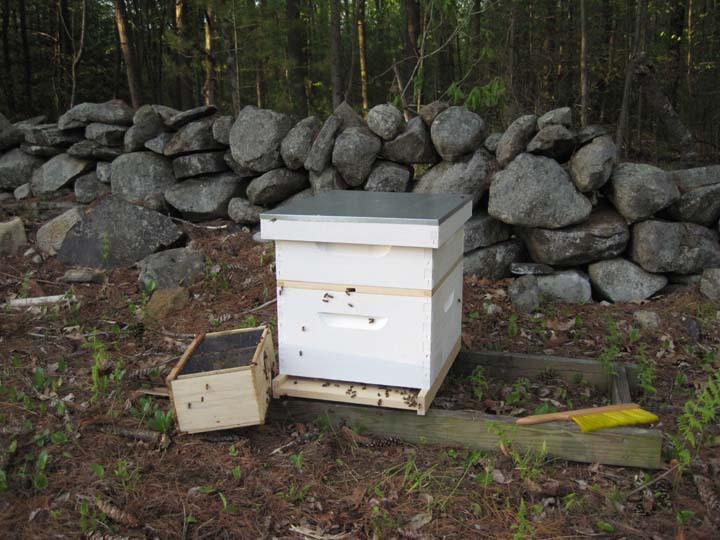
First off, I've noticed my bees could care less about me. They have no idea who I am. They have no interest in knowing who I am. When I approach the hives there is some activity, bees moving in and out of the hive entrance. The bees are doing their thing.
It is only when I lift the cover and the inner cover and move the frames that the bees begin to notice that something is amiss.
And I've noticed that each hive has its own personality.
Hive 1 & 2 are rather peaceful and even when I disturb them they tend to fly about, buzz, then go back to their lives.
But hive 3. These guys are feisty. When I disturb the hive they buzz loudly and a lot of them swarm around me. They tend to take a little longer to settle down.
It'll be interesting to see if the more docile hives produce more or less honey in relation to the more aggressive hive.
I've also noticed that bees are fragile. I've begun to wonder if the Universe wanted me to keep bees to get me to become gentle. There's not a lot of room for a bull in the china shop when it comes to tending to bees. So I'm having to be more selfaware.
I talk to my bees when I work the hive. I use pet names like "darling" and "sweetheart." Ok, so I don't use those terms of endearment with the agreesive hive. With them I say, "Guys. Settle down already." Yeesh.
All 3 hives have begun to produce comb. I'm feeding them with a mix of organic sugar/water.
So far, so good.
Wednesday, May 12, 2010

Raging Bull
I have a really bad habit. Or maybe I don't have a bad habit, but I have a habit and a preference. I have to watch one movie per day.
I'm currently working on my Top 100 Movies of All Time and so I'm revisiting all the DVDs and VHS tapes in my collection thus the buying of new movies to fill in the gaps has begun.
This past weekend I watched Raging Bull. Usually I have a very good memory for hte time, place, and format for when I've viewed movies. I have to say, when & where I first/last time watcehd Raging Bull I cannot pinpoint. It might have been art school back in 1989? This is definitely the sort of film to be taught.
The film has aged well, which is to say it hasn't really aged at all. There might be a few strands of gray hair here, maybe a couple of extra pounds around the waist, but otherwise it's in really great shape especially when you consider that it's 30 years old.
There's no reason to bore you by hashing what's been said over the years about what a great movie this is.
Instead I'd recommend it based on the following: bored by the multiplex, don't mind a bit of violence (in and out of the ring), looking to watch several power house performances -- time to watch Raging Bull.
If you can -- watch it on the largest screen possible (50" plasma?), pop a batch of popcorn, sit back and enjoy.
e
I'm currently working on my Top 100 Movies of All Time and so I'm revisiting all the DVDs and VHS tapes in my collection thus the buying of new movies to fill in the gaps has begun.
This past weekend I watched Raging Bull. Usually I have a very good memory for hte time, place, and format for when I've viewed movies. I have to say, when & where I first/last time watcehd Raging Bull I cannot pinpoint. It might have been art school back in 1989? This is definitely the sort of film to be taught.
The film has aged well, which is to say it hasn't really aged at all. There might be a few strands of gray hair here, maybe a couple of extra pounds around the waist, but otherwise it's in really great shape especially when you consider that it's 30 years old.
There's no reason to bore you by hashing what's been said over the years about what a great movie this is.
Instead I'd recommend it based on the following: bored by the multiplex, don't mind a bit of violence (in and out of the ring), looking to watch several power house performances -- time to watch Raging Bull.
If you can -- watch it on the largest screen possible (50" plasma?), pop a batch of popcorn, sit back and enjoy.
e
Sunday, May 9, 2010
Not weed.
I was going to blog about a bachelor wandering around the woods eating invasive plant species. That post would have included photos of Japanese Knotweed prepared in a couple of ways. Peeled and steamed. Simmered in a little water and sugar, a la rhubarb. And that might have lead to some good reading (or not). Then I started to investigate Japanese Knotweed and it went from invasive species to wild edible to medicinal plant. And when I got to the medicinal aspect I came to a full stop. Resveratrol? Isn't that used to fight cancer? And treat lyme disease?
But before I go on to talk about Japanese Knotweed as the Wonder Weed, let me report on the stalk as an edible. I liked it when I treated it like I would rhubarb. I wasn't a big fan when I treated it like asparagus. In both cases I found myself chewing it and spitting out the woody fibrous bits. After the rhubarb treatment I went so far as to buy strawberries and was minutes away from making a strawberry knotweed pie when I decided it wasn't worth the bother.
As I began to explore the possibilities of creating a tonic or tincture I felt like I had stumbled upon the best use for the weed and I'm glad I was too preoccupied last year to eradicate it.
I'd like to tell that I've figured out how to make a tincture but I can't. I'm still in the experimental stage.
I went into the back yard and dug up a lot of roots. Then I rinsed them in cold water and peeled off the dark brown outer layer, exposing the next layer of bright yellow/orange. Then I chopped the peeled roots into small pieces (actually I used pruners) and dumped those into a small jar. Next I poured vodka over the root pieces. I capped the jar and I'm storing it in a dark dry cabinet.
I'm going to let this sit for a bit and do a bit more research on making tinctures.
In the meantime here are a few links that might be of interest.
link 1
link 2
link 3
link 4
But before I go on to talk about Japanese Knotweed as the Wonder Weed, let me report on the stalk as an edible. I liked it when I treated it like I would rhubarb. I wasn't a big fan when I treated it like asparagus. In both cases I found myself chewing it and spitting out the woody fibrous bits. After the rhubarb treatment I went so far as to buy strawberries and was minutes away from making a strawberry knotweed pie when I decided it wasn't worth the bother.
As I began to explore the possibilities of creating a tonic or tincture I felt like I had stumbled upon the best use for the weed and I'm glad I was too preoccupied last year to eradicate it.
I'd like to tell that I've figured out how to make a tincture but I can't. I'm still in the experimental stage.
I went into the back yard and dug up a lot of roots. Then I rinsed them in cold water and peeled off the dark brown outer layer, exposing the next layer of bright yellow/orange. Then I chopped the peeled roots into small pieces (actually I used pruners) and dumped those into a small jar. Next I poured vodka over the root pieces. I capped the jar and I'm storing it in a dark dry cabinet.
I'm going to let this sit for a bit and do a bit more research on making tinctures.
In the meantime here are a few links that might be of interest.
link 1
link 2
link 3
link 4
Wednesday, May 5, 2010
a photo of a small bit of bees wax

I was curious to see how the 3rd packet of bees that had spent 2 days in their carrier would respond. I wasn't suprised to find that they had started to make wax and that they had built a small bit of comb near the queen.
I hope they like the hives that I've built and come to thrive in the community they now live in.
my first day as a beekeeper
this blog post is going to be done corporate style -- bullet points.
-- begin the day as I do everyday, in bed, asleep. Then wake up.
-- shower get dressed.
-- drive an hour and a half to the bee pick-up location.
-- become suitably impressed as I note the long line of beekeepers snaking their way out of a two car garage piled high with bee packages.
-- gather needed equipment (supers, covers, bee suit, bee brush, hive tool book on beekeeping, frame components).
-- pick up 3 packagees of bees with marked queens
-- ask owner of the bee business if I'm insane to not medicate my bees. He looks at me. Then he says you have a 75% of the hive making it through the first season. I like the sound of that.
-- drive an hour and a half back home with the AC running full blast to keep the bees cool.
-- take bees out of car place them outdoor sin the shade where there's a nice breeze.
-- drive to hardware store: purchase paint, paint brush, and nails.
-- drive back home.
-- begin to assemble hive. (paint supers and build frames).
-- notice that a fast-moving thunderstorm is about to break, dash outdoors, grab bee packages race inside and place bees in the livingroom.
-- thunderstorm passes (in dramatic fashion), place bees back outdoors.
-- notice that it's getting late and pick up the pace to finish at least one hive.
-- mix up a batch of bee food. 1 part water to 1 part organic sugar. mix 1 quart.
-- get one hive complete in the pasture. (marvel at watching the bees take care of each other after I have placed the queen in between frames and dumped the bees into the brood chamber. the bees start to sort themselves out).
-- note that beekeeping is more beautiful than I thought it would be, then collect myself and race back to the house.
-- complete a second hive as the last light of day fades.
-- bring 3rd package of bees indoors for the night.
-- eat dinner.
-- finish building 10 more frames.
-- inspect bees that are spending the night with me and note that they are very quiet and hang in a delicate cluster around the feeder can and queen container. I realize that bees are diurnal.
-- say good night to bees
-- 10:45 pm collapse into bed, fall asleep fully clothed.
-- begin the day as I do everyday, in bed, asleep. Then wake up.
-- shower get dressed.
-- drive an hour and a half to the bee pick-up location.
-- become suitably impressed as I note the long line of beekeepers snaking their way out of a two car garage piled high with bee packages.
-- gather needed equipment (supers, covers, bee suit, bee brush, hive tool book on beekeeping, frame components).
-- pick up 3 packagees of bees with marked queens
-- ask owner of the bee business if I'm insane to not medicate my bees. He looks at me. Then he says you have a 75% of the hive making it through the first season. I like the sound of that.
-- drive an hour and a half back home with the AC running full blast to keep the bees cool.
-- take bees out of car place them outdoor sin the shade where there's a nice breeze.
-- drive to hardware store: purchase paint, paint brush, and nails.
-- drive back home.
-- begin to assemble hive. (paint supers and build frames).
-- notice that a fast-moving thunderstorm is about to break, dash outdoors, grab bee packages race inside and place bees in the livingroom.
-- thunderstorm passes (in dramatic fashion), place bees back outdoors.
-- notice that it's getting late and pick up the pace to finish at least one hive.
-- mix up a batch of bee food. 1 part water to 1 part organic sugar. mix 1 quart.
-- get one hive complete in the pasture. (marvel at watching the bees take care of each other after I have placed the queen in between frames and dumped the bees into the brood chamber. the bees start to sort themselves out).
-- note that beekeeping is more beautiful than I thought it would be, then collect myself and race back to the house.
-- complete a second hive as the last light of day fades.
-- bring 3rd package of bees indoors for the night.
-- eat dinner.
-- finish building 10 more frames.
-- inspect bees that are spending the night with me and note that they are very quiet and hang in a delicate cluster around the feeder can and queen container. I realize that bees are diurnal.
-- say good night to bees
-- 10:45 pm collapse into bed, fall asleep fully clothed.


Subscribe to:
Posts (Atom)